Edith B. Nettleton Historical Room Photograph Collection
Title
Edith B. Nettleton Historical Room Photograph Collection
Description
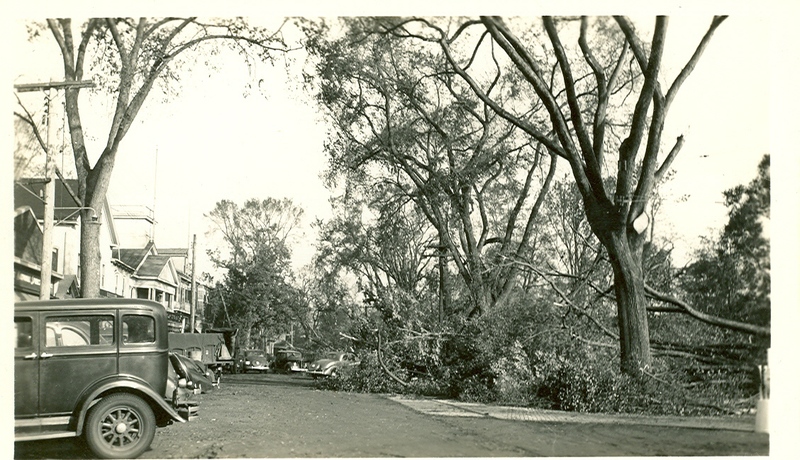
This collection includes hundreds of historical photos of Guilford and environs, including scenic views, portraits, activities, celebrations, events, homes and businesses. Highlights include several photos of the aftermath of the Hurricane of 38 as well as ...
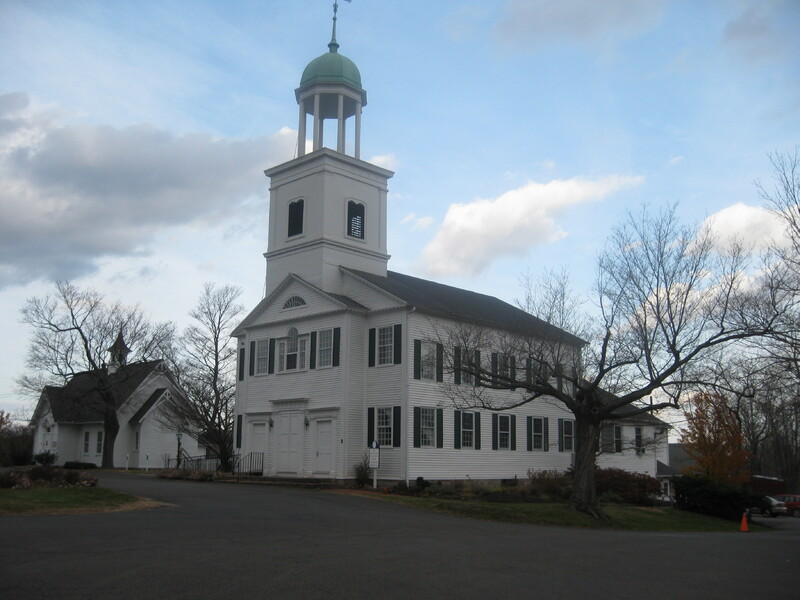
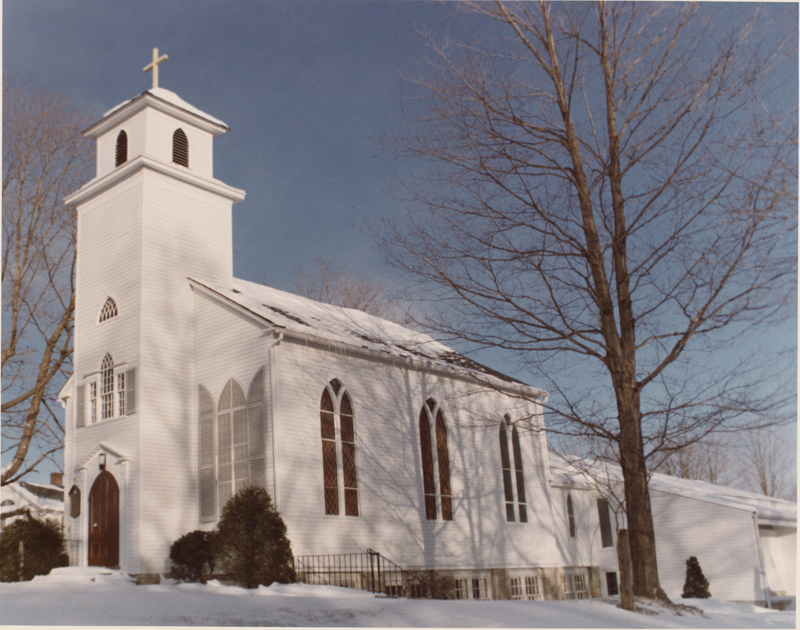
From 1705 to 1719, men in Guilford who worked the land in North Guilford spent their weeknights in leantos and tents and travelled home on the weekends, giving North Guilford the name “Cohabit.” In 1719 they petitioned to establish a separate community, named by the General Assembly on May 12, 1720 as the “Guilford North Society,” and renamed “North Guilford Society” in May 1727. “Ledge Hill,” the highest point in North Guilford, was chosen in 1720 as the site for the North Guilford Congregational Church. The first meetinghouse was built where the church’s cemetery is now located. Construction of the present building was begun in 1812, and the building was dedicated in 1814, making it the oldest church in continuous use in the town of Guilford. A philosophical difference in 1746 led to the donation of land for the construction of St. John’s Episcopal Church, founded in 1751 after members split from the Congregational Church. To the left of the meeting house is Parish Hall, built in 1888, and now home to North Guilford Nursery School.
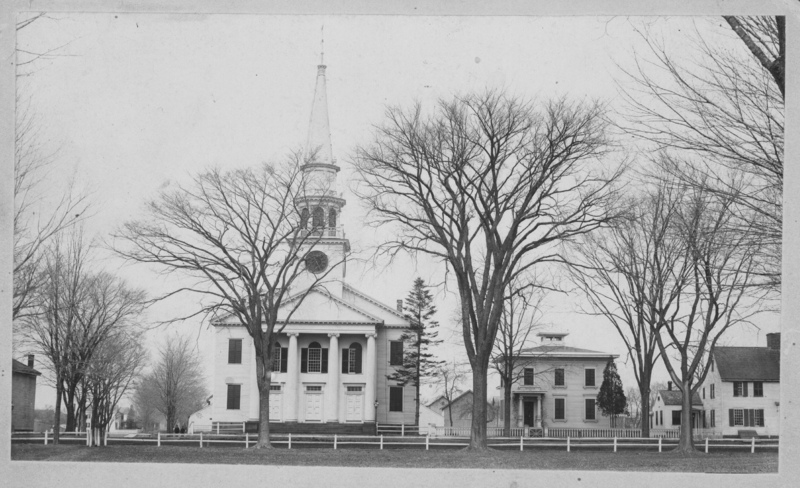
First Congregational Church, 110 Broad St, north end of the Green. Photo, a gift from Bernard Steiner is pre-1899, when the split rail fence was removed from the Green. The first meeting house, made of stone, was erected on the northwest part of the Green probably in 1643, when the church was gathered. The second building, also on the Green, was finished in 1713. A deal was struck in 1829 with Lot Benton to acquire the land where the church now stands. The second building was razed in 1830, the year the present building was dedicated. The building cost $7,500 and was built by Ira Atwater. The bell, which was first cast in 1725, and the clock, which was assembled in 1776 by Ebenezer Parmalee, were reused from the previous meetinghouse. Church Street, which opened in 1825, exists as a single lane to the west of the church. Carriage/horse sheds are visible on each side at rear of church. The church parsonage, to the right, was moved to 28 Conway Drive in 1964. The Tabor Smith house, next to the parsonage, was torn down in 1906.
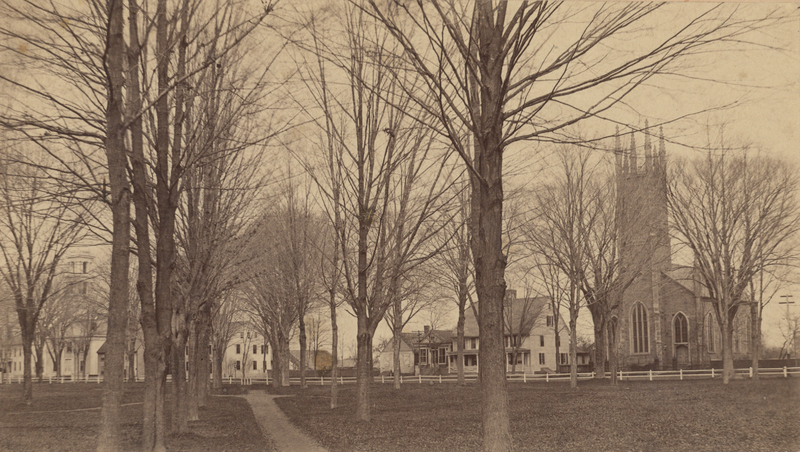
Looking across the Green to Park St, pre-1885.
Christ Church was organized in 1744 by Samuel Johnson, who went on to become first president of King’s College, now Columbia University. The first church was built in 1748 on the Green. In 1834 that building and the poplar trees around it were sold to help finance construction of the present church. Construction began in 1836 with 100 tons of granite from the Sawpit Quarry hauled by oxcart, with sand for the mortar from the “Sandy Hill” section of Nut Plains. The building was consecrated in 1838.
The house north of the church, belonging to Dr. John Redfield, was disassembled in 1937 and moved to 47 Broad St, where it was rebuilt without the porch. According to Charles D. Hubbard, “Around the Green in the 80’s (printed in Milestones of Old Guilford), “The earliest occupant I can remember was Doctor Harris Pendleton, the druggist, who kept store in a small building close by, later used as post office, and finally relegated to the back yard of the Town Hall. Close to the drug store, standing where the present drive to the Town Hall is local was Mr. Horatio Johnson’s liquor store…It had wooden shutters closed with a diagonal iron bar and a fireplace.” Next, continuing to the north, is the town mow lot, now the site of Town Hall, then Charles Hubbard’s home at 37 Park St, 43 Park St, 49 Park St (Christian Science Church) and 55 Park St (Major Lathrop House).
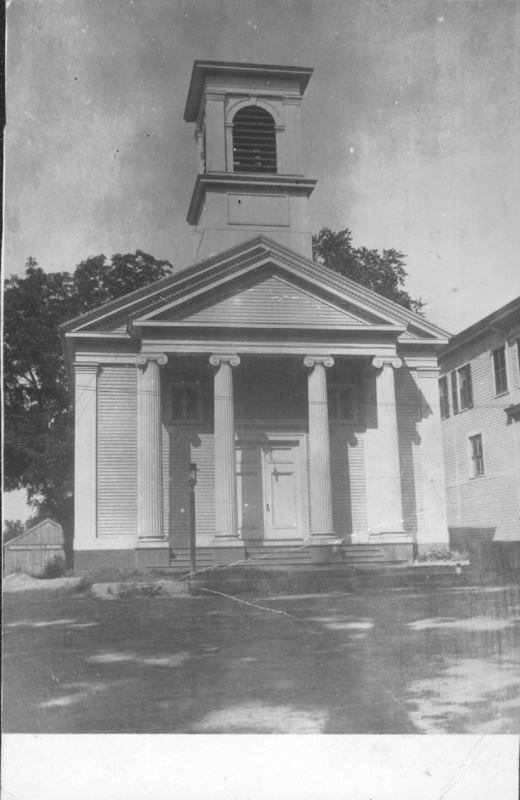
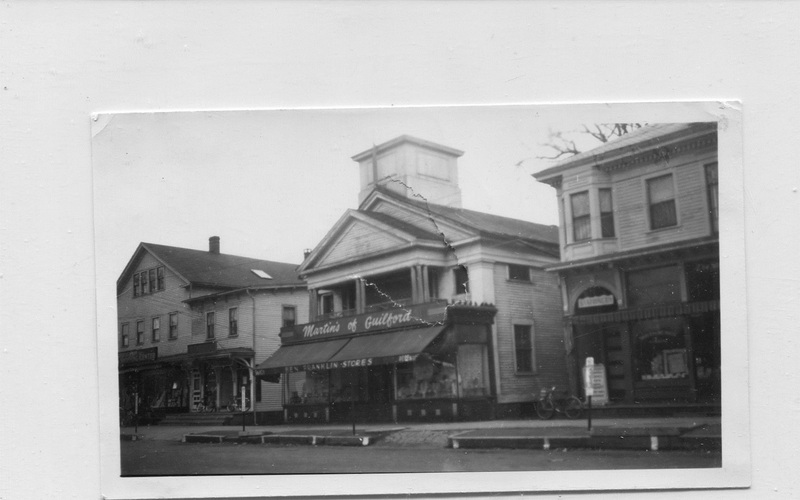
The Methodist Church was built in 1837-38, with the portico and pillars added in 1869 for the Methodist Society, which disbanded in 1921 when its members united with the First Congregational Church. At that time, the pillars and steeple were removed. It was subsequently headquarters for Darrow Post, American Legion. Later it was acquired by Paul Cianciolo. It housed the Ben Franklin Stores, and later, Martin’s of Guilford. In 1947, Marcius K. Scott bought the building and lowered it to sidewalk level to house Mr. Scott’s grocery and meat market business.
65-67 Whitfield Street, Martin's of Guilford, Ben Franklin Stores. 65-67 Whitfield Street has been the home of several businesses including Ben Franklin Stores and Martin’s of Guilford. The Ben Franklin Store closed in 1945. In the century prior, the Methodist Church was built at this location in 1837-38 with the portico and pillars added in 1869 for the Methodist Society, which disbanded in 1921 when its members united with the First Congregational Church. At that time, the pillars and steeple were removed. It was subsequently headquarters for Darrow Post, American Legion. Later it was acquired by Paul Cianciolo. It housed the Ben Franklin Store, and later, Martin’s of Guilford. In 1947, Marcius K. Scott bought the building and lowered to sidewalk level to house Mr. Scott’s grocery and meat market business.
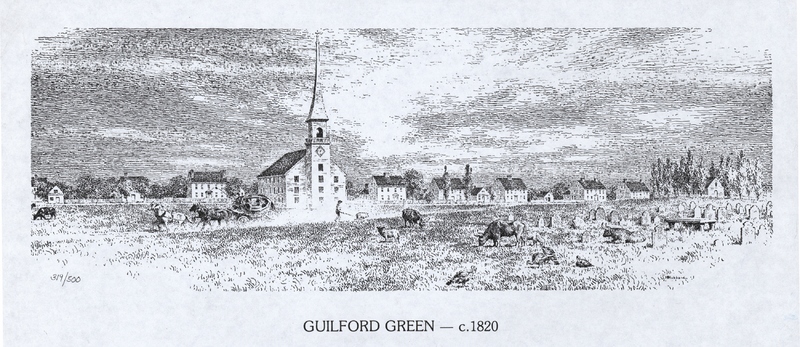
Guilford Green ca. 1820, Ink Sketch (12” ½ x 22”) by Charles Hubbard (1876-1951). Second meeting house (1712) of First Congregational Church is on the Green, with its burial ground and grazing cattle. The diagonal road for stage coaches between New York and Boston passed through the Green and was made part of the great mail route from Georgia to Maine. Published in the First Church Manual, 1930
Guilford Green’s northeast corner, intersection of Broad and Park Streets. The first building on the left is George Walter’s Feed Store, which stood on what is now the site of the Guilford Free Library. Walter sold his business in 1913. The large white house south of the Feed Store is the Jedediah Lathrop House, 55 Park Street. The rail fence was removed from the Green in 1899.
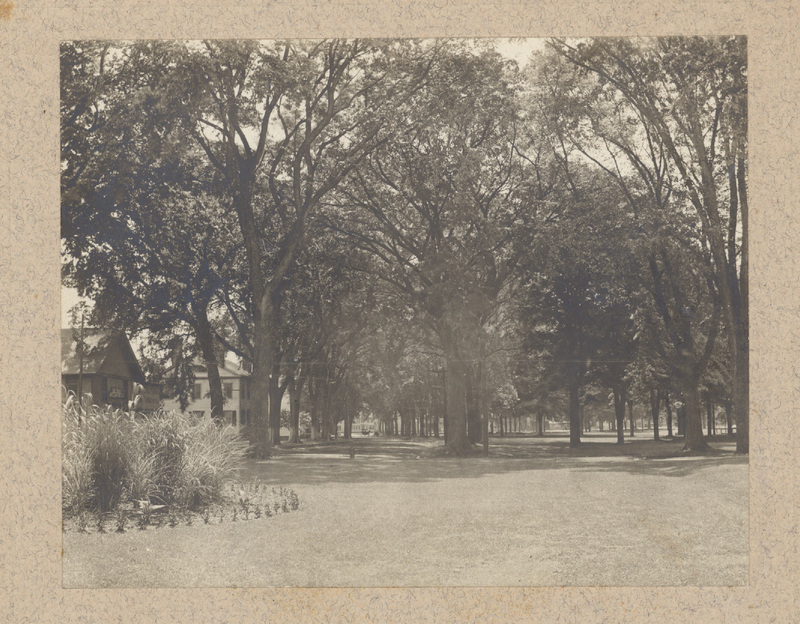
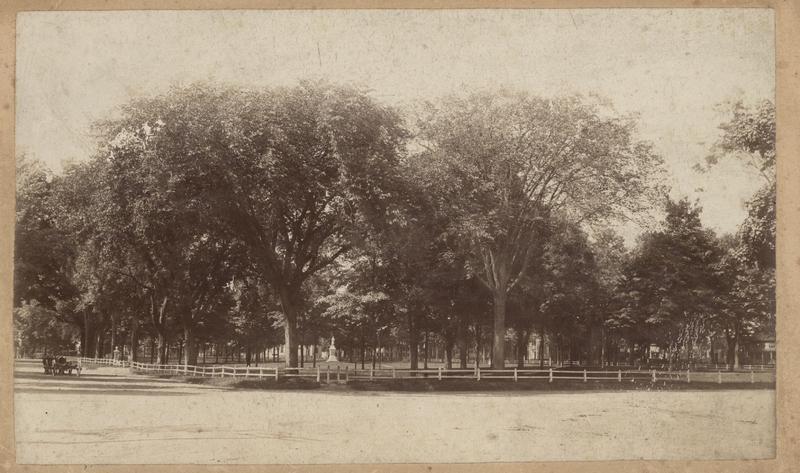
Southwest entrance to the Guilford Green. Corner of Boston St. and Whitfield St. After the incorporation of the Borough of Guilford in 1815 the improvement of the Green began in earnest, with tree planting, animal restrictions, and walkways. It was officially named a “Publick Square” and on the 1868 Beers Atlas it is called a “Park,” a concept reinforced by naming the street bordering the east side “Park Street.” Further improvements came after the 1874 formation of the United Workers for Public Improvement, a group made up exclusively of women who had 80 lamps erected and paid a man to keep them lit. They gathered annually in the spring to rake the green, accompanied by ringing church bells and the firing of the cannon. The Civil War Monument was dedicated on Memorial Day, 1877.
Fitz-Greene Halleck House, 25 Water Street, Guilford. The poet was dubbed "the American Byron." He was born in Guilford July 8, 1790 and moved to New York City in May 1811 where he associated with the New York-based Knickerbocker Group. He lived in the Water Street house from 1837-1867 and after his death November 19, 1867, was buried in Alderbrook Cemetery. In 1877, a statue was erected to him on the Literary Walk in New York City's Central Park.
2785 Boston Post Road. Noah Fowler built this house for his son Miner who married Rachel Hall. The Fowlers had 6 children, 2 of whom were deaf. Sophia, born in 1798, her sister Parnel, and her cousin Ward were sent to Gallaudet School in Hartford. Sophia married her teacher, Rev. Thomas H. Gallaudet in 1821, and their sons continued the school. In 1917, a bronze plaque was placed on a boulder outside the birthplace of Sophia to commemorate her.
Ward/Foote Home. 829 Goose Lane. General Andrew Ward, Revolutionary Ward hero, had a daughter, Roxana, who married Eli Foote. They had 10 children. When Eli died, Roxana and the children moved back to her parents’ home. The second oldest child, Roxana Foote, married Lyman Beecher and their illustrious brood included Henry Ward Beecher and Harriet Beecher Stowe. Upon the death of her mother, Roxana Foote Beecher in 1816, Harriet Beecher spent time at this, her grandparents' home.
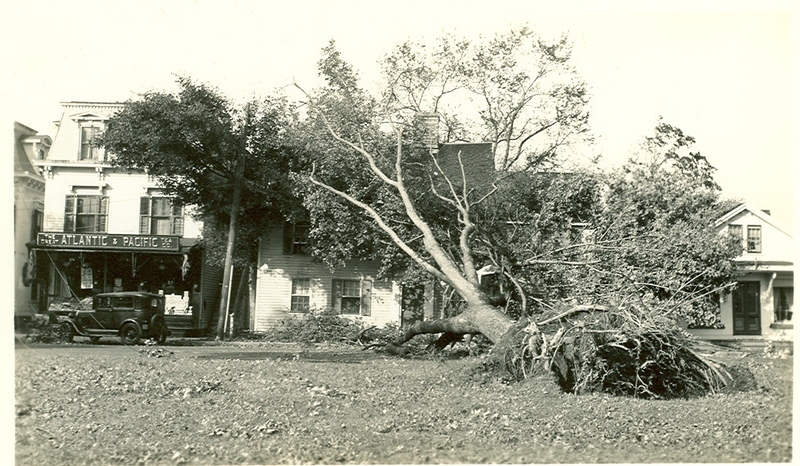
The west side of the Guilford Green facing Whitfield St. after the Hurricane of 1938. The Atlantic and Pacific Tea Co. is 25 Whitfield Street, obscured behind the tree is 21 Whitfield Street, and the structure on the right is 17 Whitfield Street.
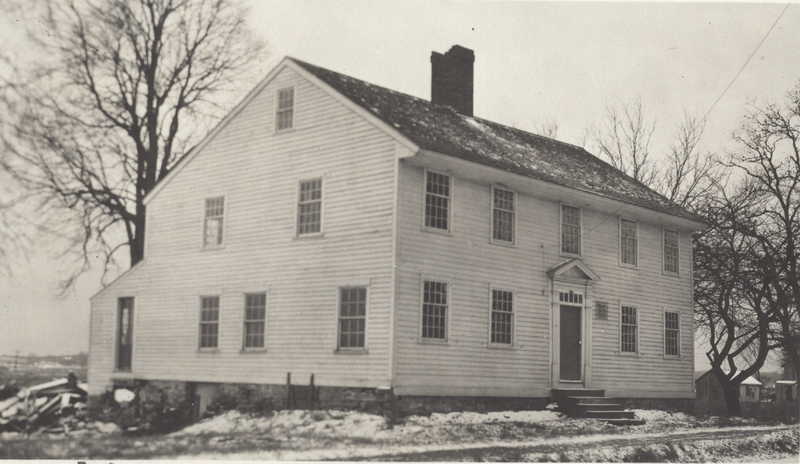
This house was originally on Broad Street, on the site where the First Congregational Church now stands. Lot Benton and his wife, Catherine Lyman (of Middletown) had no children of their own but had adopted Mrs. Benton’s nephew, Lyman Beecher. Lyman Beecher came to this house on vacations from Yale, and it was in Guilford that he met his future wife, Roxana Ward. Their children included Harriet Beecher Stowe and Henry Ward Beecher. The house and land were left by Lot Benton to Lyman Beecher, who sold the land to the church in 1829 to facilitate the removal of the church from the town green. The house was moved by 35 yoke of oxen to its present location near the sluice dock, 485 Whitfield Street. The house was owned by Judge Harry Durant in 1921 when this photo was taken.
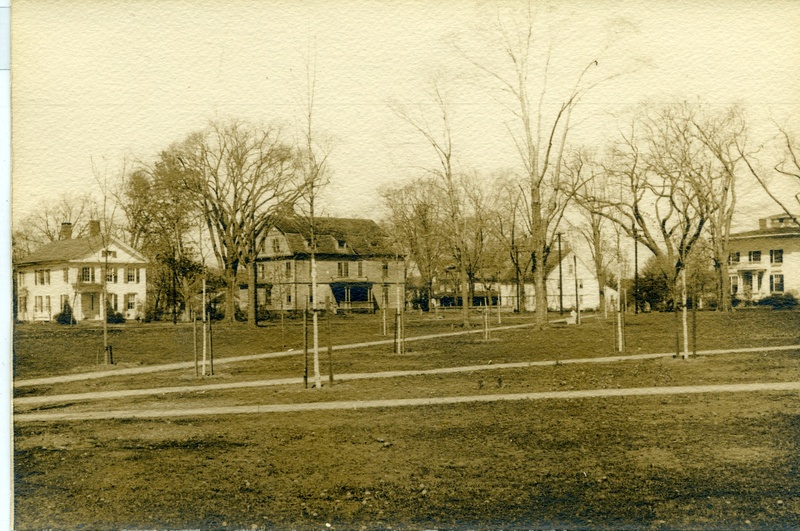
Replanting the Guilford Green after the Hurricane of 1938. Facing the northwest corner, intersection of Whitifield and Broad Streets. From left to right: 15 Whitfield St., 1 Whitfield St., 76 Broad St., 88 Broad St.